- Artificial intelligence
- Events
- Workflow
Automatic face recognition and logo recognition: how digital asset management makes sports photos usable in seconds
How automatic face and logo recognition in digital asset management keywords thousands of sports photos in seconds and distributes them to the right recipients. With a practical example and FAQ.
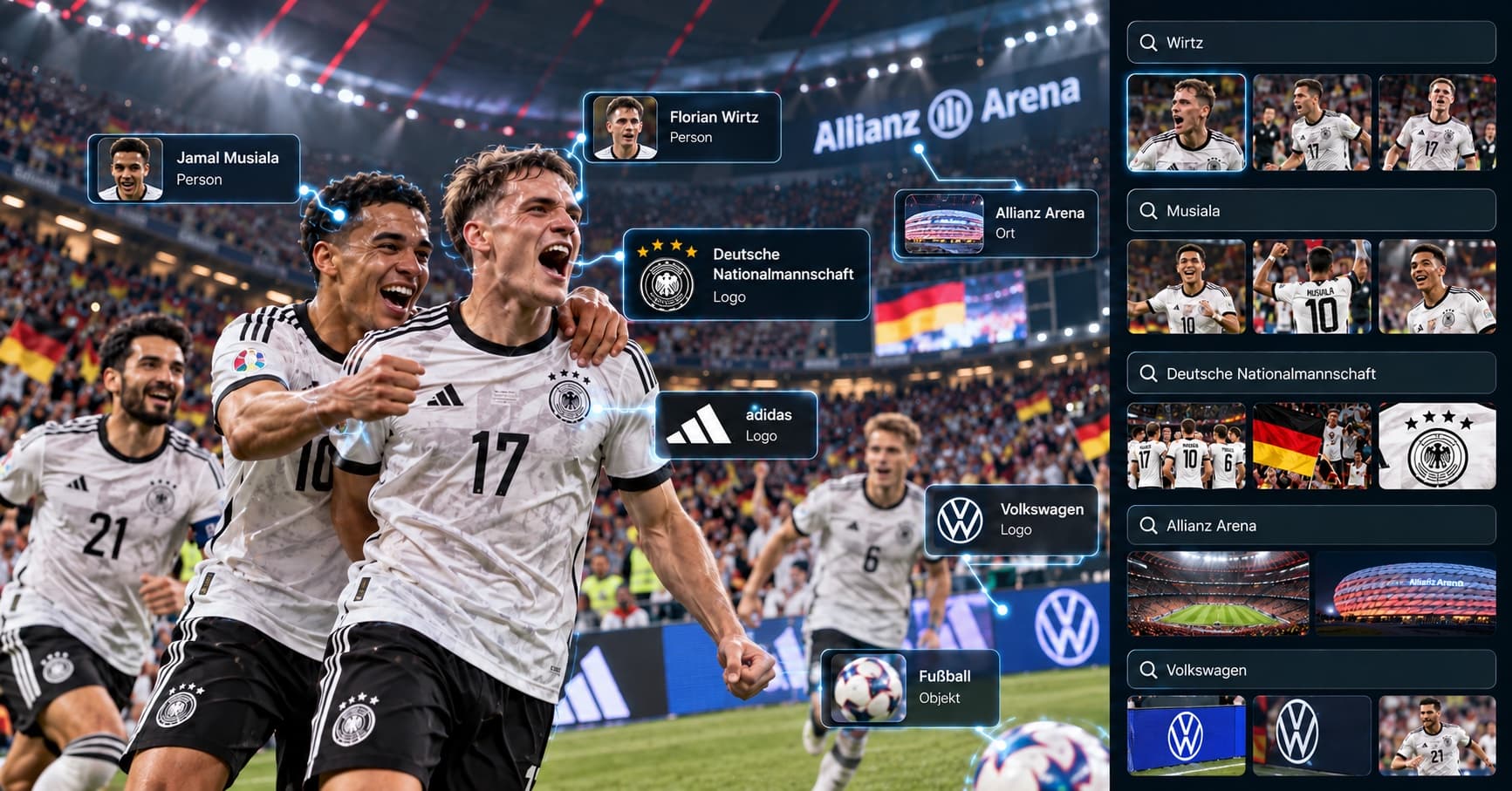
When the German national team plays at the Allianz Arena, a single evening easily produces several thousand photos: players in action, goal celebrations, advertising boards in the background, atmosphere shots from the stands. For clubs, agencies, sponsorship partners and marketing teams, this raw material is a potential treasure, but only if it can be tapped in minutes rather than days. This is exactly where automatic face recognition and logo recognition in digital asset management (DAM) come in.
In this article we explain what automatic face recognition and logo recognition mean in a DAM context, how they work, and why they matter not just on match days but for any company that regularly manages large amounts of image material.
The problem: a flood of images at live events and on match days
A Bundesliga or international match night produces many times the image volume of an ordinary photo shoot in a short time. Several photographers work at once, each delivers hundreds to thousands of shots, and ideally the images need to be usable during the match or immediately afterwards, for live posts, the press office or sponsorship partners.
The classic approach, reviewing images by hand, captioning them with player names and assigning them to the right recipients, hits clear limits at these volumes. Anyone keywording manually quickly needs several working hours for a thousand images, often with several people at once, and the result depends heavily on how well each person recognises players and logos. Images that aren't keyworded in time often vanish into the archive, impossible to find, even though they are valuable material.
The same basic problem, in a different form, affects practically every company with a large volume of images: trade fairs, product shoots, events, campaigns with several testimonials or partner logos. Everywhere the same question comes up: who or what is actually in this picture, and how does it get to the right recipients quickly?
What is automatic face recognition in digital asset management?
In a DAM context, automatic face recognition is a feature in which software independently recognises people in uploaded images and stores that recognition as tags or metadata on the image, without anyone having to look at and caption the image by hand. Instead of an editor opening every single photo and entering who is in it, the system takes over this step automatically, usually within a few seconds per image.
In practice this means: as soon as photos from the sideline are uploaded to a DAM system such as VAULO, the software automatically recognises which players appear in which image and assigns the corresponding tags. You can then search for individual players directly, instead of clicking through thousands of unlabelled files.
What is automatic logo and brand recognition?
Automatic logo recognition works on the same basic principle, but it concerns brands and sponsorship logos visible in an image rather than people, for example on advertising boards along the pitch, on shirts or on banners. The software identifies which logo can be seen in which image and can use that to assign images automatically to the matching advertising and sponsorship partners.
For clubs and marketers this is more than a convenience: sponsorship partners usually expect prompt image material showing their logo, for their own communication or as proof of the agreed visibility. When this assignment happens automatically, there is no more manual searching for which of the thousands of images shows which partner logo.
How automatic keywording works in practice
The process can be described, simplified, in three steps.
- First, the photos are uploaded into the central DAM system, for example straight from the camera (VAULO's LiveUpload) on the sideline or at another live event.
- Second, the software analyses the images automatically: it recognises faces or people and assigns player tags, and it recognises logos on advertising boards or other surfaces and matches them to the corresponding brands.
- Third, the keyworded images are immediately searchable in the archive, and images with a particular sponsorship logo can be filtered specifically and forwarded directly to the respective partner, instead of someone first having to search through the material by hand.
So the decisive difference from a classic, unstructured image folder is not just central storage as such, but that the content of the images itself becomes machine-readable and therefore searchable.
Benefits for clubs, agencies and marketing teams
Automatic face and logo recognition pays off in several areas, well beyond a single match day.
- Sports clubs and marketers can deliver sponsorship reports faster, because images with a particular partner logo can be compiled in seconds rather than hours.
- PR and marketing agencies with many campaign images and several testimonials or brand partners save considerable manual review effort when people and logos are recognised and tagged automatically.
- Trade fair and event organisers, where a single day likewise produces a great many photos with different exhibitors, speakers and partner logos, benefit from the same principle: automatic assignment instead of manual post-processing.
- Companies with recurring photo shoots, such as product shoots with several brand partners, can keep their image archive structured and searchable for the long term, instead of every new shoot adding more unsorted material.
In all of these cases the same basic idea applies: automatic recognition decides whether you end up with a usable, searchable archive or a growing mountain of images that nobody fully works through any more.
Automatic recognition compared with manual keywording
The difference between automatic and manual keywording shows most clearly in speed and consistency. Manual keywording is time-consuming, depends on the attention and expertise of the person doing it, and at high image volumes is often not done at all or only partly, simply because there isn't time. Automatic recognition, by contrast, delivers consistent results in seconds, whether it's ten images or ten thousand, and noticeably relieves editorial and marketing teams of repetitive review work.
That doesn't mean manual checks disappear completely: for particularly sensitive or high-profile shots, a quick human look remains sensible. The decisive advantage is that the groundwork, reviewing and first assigning thousands of images, no longer has to be done by hand.
Frequently asked questions
What is the difference between face recognition and logo recognition in a DAM?
Face recognition identifies people in an image and assigns the corresponding tags, such as player names. Logo recognition identifies brands and sponsorship logos in an image, for example on advertising boards, and assigns the image to the corresponding partner. The two features work independently of each other but can be combined in the same system.
Which companies benefit from automatic image recognition in a DAM?
In principle, any organisation that regularly manages large amounts of image material with recurring people or brand partners, such as sports clubs, marketers, PR and marketing agencies, and companies with frequent events or campaigns involving several partners.
How quickly are images keyworded with automatic recognition?
Usually within a few seconds per image, directly after upload to the DAM system, regardless of the total number of images uploaded.
Does automatic recognition fully replace manual image checks?
No. Automatic recognition takes over the time-consuming groundwork of keywording. Occasional manual checks, especially for sensitive or particularly high-profile shots, remain sensible and possible.
How are automatic recognition and search in the image archive connected?
Only automatic keywording makes image content such as individual people or logos searchable in the first place. Without these tags, an archive can only be searched by file name or upload date; with automatic recognition, you can search specifically by subject or brand.
Automatic recognition as part of a wider DAM strategy
Automatic face and logo recognition only reaches its full value in combination with the other core functions of a digital asset management system: central storage instead of scattered folders and inboxes, targeted search and filtering via tags and metadata, and clear access rights so that every person and every partner only sees the images released to them. Recognition alone solves only half of the image-flood problem; the other half is handled by the structure into which recognised images are then sorted.
So anyone thinking about automatic image recognition shouldn't look at it in isolation, but as one building block in an end-to-end DAM workflow: from upload through automatic keywording to targeted distribution to internal teams or external partners.
Is automatic recognition worthwhile for smaller image volumes too?
The biggest effect shows at high image volumes, such as on match days, at trade fairs or in large campaigns. But even with more modest volumes, automatic keywording saves time and ensures images are tagged consistently from the start, instead of relying on later post-processing that often never happens.
Conclusion
Whether it's an international match night, a trade fair or a campaign with several partners: wherever a great many images with recurring people and logos are produced in a short time, the ability to recognise and assign content automatically becomes the deciding factor in whether an image archive actually gets used in the end. VAULO combines automatic face recognition and logo recognition with central, searchable storage, so images are not just stored but found again within seconds and distributed to the right recipients.
Want to know what automatic image recognition could look like in your own image archive? Talk to the VAULO team and have the feature shown to you on your own sample images.